
An Overnight Shift on a Hosted Mining Floor
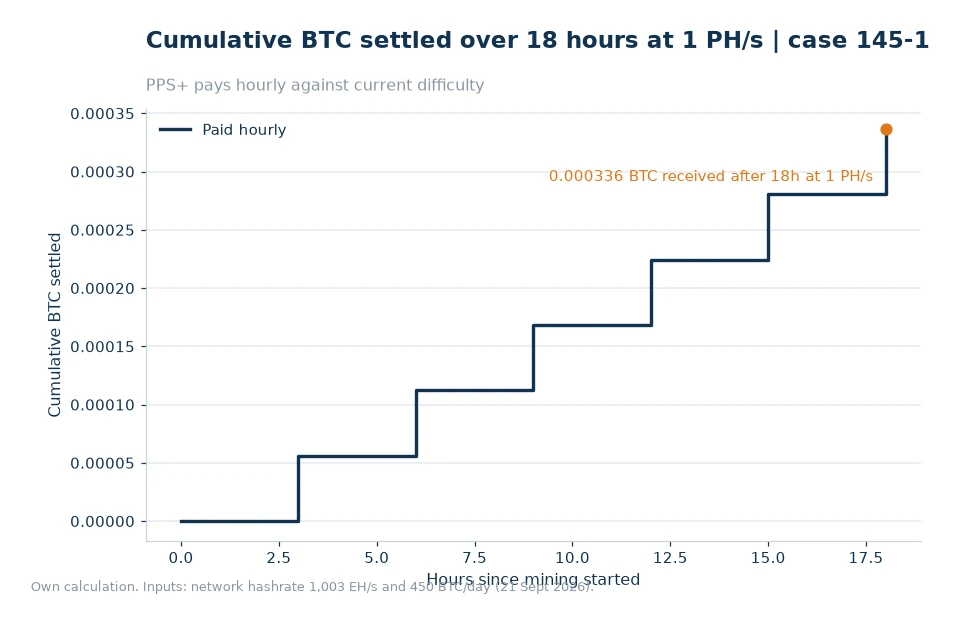
The night shift is where a mining site either holds its numbers or quietly loses them. Nobody is watching the price, the sales team is asleep, and the only work is the work of noticing. Eighteen hours at 1 PH/s should credit 0.00033645 BTC, about $28.50 at $84,692 per BTC, and the job is to make sure all eighteen steps appear rather than seventeen.
Key takeaways
- An eighteen-hour stretch at 1 PH/s is 0.00033645 BTC, so each missing hour costs 0.00001869 BTC.
- Log three readings an hour: hashrate, exhaust temperature and rejected share rate.
- Escalate on a trend, not on a single reading, except for temperature and smoke.
- Handover notes should name machines and times, not describe the mood of the shift.
The shift starts before the previous one ends
Good handover takes ten minutes and saves an hour. The outgoing technician should point at the machines that are not behaving, not the ones that are. A rack that has been stable for a month needs no introduction; the unit that dropped off the pool at 22:40 and came back at 23:05 needs a sentence, a name and, if it matters, a photograph of the log.
Ask three questions at the changeover. What is the current fleet hashrate against the figure at the start of the last shift? Which units are tagged for repair, and what is the expected return time? Has anything changed in the cooling plant, the network or the power feed that I should know about? The answers fit on half a page, and that half page is the difference between a shift that continues and a shift that starts from zero.
Reading an eighteen-hour trace
The curve for this piece is eighteen hours at 1 PH/s, plotted every three hours. Each plotted point is the sum of three hourly credits. A flat segment between points is normal, because the credit is batched hourly and the chart compresses it; a segment that slopes downward is not possible under PPS+, since credits only accumulate. If a segment ever looks flat for longer than it should, the pool state page will show whether the whole pool paused or only your rack did.
What the trace cannot show is the shape inside each three-hour block. That is why the hourly log matters. A unit that was offline for forty minutes and then returned will still let the three-hour total look approximately right, and the loss hides in the gap between what the account credits and what the rated hashrate implies. Comparing the two is the core skill of the shift.
The readings worth writing down
Hashrate first, in the same unit every time. Mixing terahashes and petahashes in a notebook is how a ten percent drop gets recorded as a rounding error. Second, exhaust temperature at a fixed point on each rack, because a rising trend at one point usually means a fan is failing or a filter is loading up. Third, rejected shares as a percentage, since a jump from a fraction of a percent to several percent points at a network or configuration problem rather than a hardware one.
Add one more reading if the site meters power: actual draw per rack. A machine drawing less than its normal figure is either hashing less or has changed its power limit, and both matter. A machine drawing more is likely running hotter, which connects back to the temperature column. Four numbers per rack per hour is enough to reconstruct almost any incident after the fact.
When a number deserves a phone call
The temptation at 3 a.m. is to escalate everything or nothing. Set thresholds in daylight and follow them at night. A single rack reading five percent below its baseline is a note. The same rack twenty percent below for two consecutive hours is a call. Any reading that suggests a thermal event, a burning smell, water where water should not be, or a breaker that has tripped twice is a call regardless of the hour.
Escalation paths should be written into the hosting agreement, not improvised. A contract that names a response time and a contact for out-of-hours incidents is worth more than one that promises vague support. The ViaBTC Mining Farms page lists hosting options, and the questions to ask about night coverage are the same ones that matter at any other hour: who answers, how quickly, and what authority they have to move your machines.
A phone alert is not a substitute for the walk, but it is a useful second pair of eyes between rounds. The ViaBTC App can notify a phone when hashrate falls below a level you set, which means a technician in another aisle still hears about a rack that has gone quiet.
| Hour | Expected BTC | Watch item | Escalate if |
|---|---|---|---|
| 3 | 0.00005608 | Fans settling after dusk | A rack is 10 C above baseline |
| 9 | 0.00016823 | Rejected share rate | Rejects above 2 percent for an hour |
| 15 | 0.00028038 | Hashrate against rated speed | Fleet 15 percent below rated |
| 18 | 0.00033645 | Credit against expectation | Two or more hourly credits missing |
The expected column assumes continuous running and the 21 Sept 2026 network rate. If the site is at a different hashrate, scale linearly: at 2 PH/s the eighteen-hour figure doubles to 0.00067291 BTC, and every threshold in the last column stays the same because it is expressed as a percentage.
Worked example
Turn the shift total into a per-hour checkpoint you can use at the desk.
- Daily credit at 1 PH/s: 450 ÷ 1,003,000,000 × 1,000 = 0.00044861 BTC.
- Hourly credit: 0.00044861 ÷ 24 = 0.000018692 BTC.
- Three hours: 3 × 0.000018692 = 0.00005608 BTC, or $4.75.
- Nine hours: 9 × 0.000018692 = 0.00016823 BTC, or $14.25.
- Fifteen hours: 15 × 0.000018692 = 0.00028038 BTC, or $23.75.
- Eighteen hours: 18 × 0.000018692 = 0.00033645 BTC; at $84,692 that is $28.50.
- One missed hour is 0.000018692 BTC, about $1.58 — small per event, but the log exists to catch the event before it becomes a pattern.
If the account total at hour eighteen is short by two credits, the arithmetic says the site lost roughly 0.00003738 BTC, or $3.17. The dollar figure is not the point. The point is that a two-hour gap is a fact you can date, and dating it is what makes the next conversation with the host useful.
Frequently asked questions
What should an overnight checklist contain?
Hashrate, exhaust temperature, rejected share percentage and power draw per rack, logged hourly against a baseline. At 1 PH/s the shift should accumulate 0.00033645 BTC over eighteen hours.
How quickly should a night technician escalate?
Immediately for heat, smoke, water or a repeated breaker trip; after two consecutive hours for a hashrate shortfall of twenty percent or more.
How do I know the credits match the shift log?
Compare the account's cumulative figure at the end of the shift with 0.00001869 BTC per petahash per hour; a shortfall of two or more steps is worth documenting.
Hand the floor over cleaner than you found it
The measure of a night shift is not how busy it felt. It is whether the morning technician inherits a floor with no surprises and a page of facts. Write the log while the shift is happening, not at the end, and write it in a form the next person can act on: machine name, time, reading, action taken. Anything vaguer becomes a story rather than a record.
Before you leave, walk the aisles once with the lights on. Listen for a fan with a bearing on the way out, look for dust accumulated on an intake since the last clean, and check that every tagged unit has a note. Then confirm the eighteen-hour total against the expected figure and sign the handover. A site that does this every night is a site where the arithmetic and the reality stay close, which is most of what operational discipline means in mining.
Sources: ViaBTC farms listing for hosting terms and the fee page for the listed 4% on the PPS-settled block reward[1]. On 21 Sept 2026 the chain showed difficulty at 132.76 T, network hashrate near 1,003 EH/s, a 3.125 BTC subsidy, 144 blocks a day and BTC at $84,692. Published 24 Oct 2026 from figures read 21 Sept 2026.